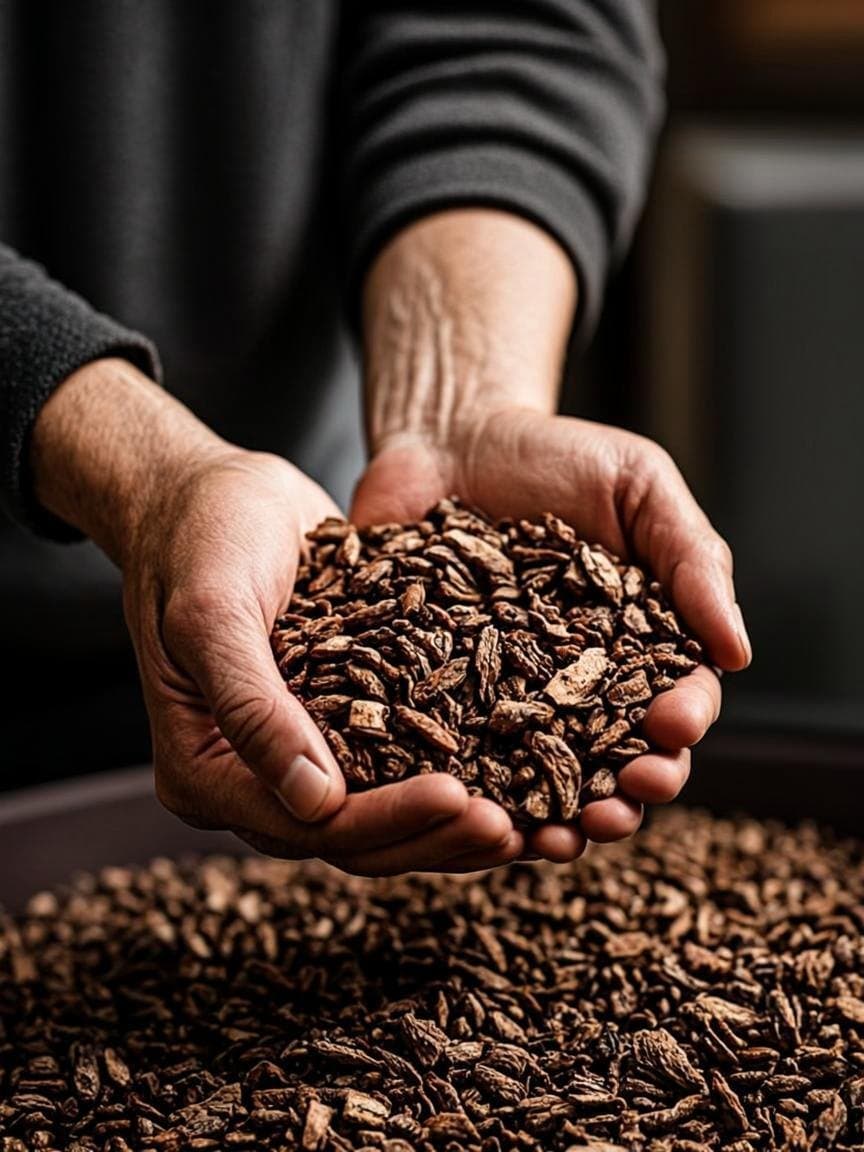
Every gasification project begins with the same question, and it is not about reactors: it is whether the material you intend to convert can actually sustain the process — economically, continuously and within emission limits. Feedstock determines reactor selection, gas cleaning complexity, ash handling strategy and, ultimately, the bankability of the entire project.
Across our feasibility work, three properties separate gasification-ready fuels from expensive surprises: moisture, ash chemistry and consistency.
A feedstock that looks free on paper can be uneconomic once drying energy and handling are priced in.
Moisture sets the energy ceiling
Thermochemical gasification requires heat to dry, pyrolyse and reduce the fuel. Every kilogram of water in the feedstock absorbs energy that would otherwise be available for conversion. Air-blown fixed and fluidized bed systems generally perform best below roughly 15–20% moisture; above 30–35%, autothermal operation becomes difficult without feedstock pre-drying — and pre-drying consumes energy and capital that must be paid for somewhere.
This is why proximate analysis on representative, correctly stored samples is the first technical milestone of any serious project. A feedstock that looks free on paper can be uneconomic once drying energy and handling are priced in.
Ash chemistry decides availability
Ash content matters less than ash behaviour. The same 5% ash fraction can be benign in one fuel and plant-killing in another, depending on fusion temperature and oxide composition. Fuels rich in potassium and chlorine — straw, many agro-residues — form low-melting compounds that slag fluidized beds and foul heat surfaces.
Ash fusion testing and oxide composition analysis convert this risk into numbers: slagging and fouling indices that feed directly into reactor temperature selection, bed material strategy and gas cooling design.
Consistency is the underrated variable
Gasification systems are engineered around a design fuel. Real projects run on fuel blends that change with season, supplier and market. The plants that perform are those designed with honest envelope analysis — the full range of expected fuels, not just the optimistic average.
Our laboratory programme exists for precisely this reason: characterize the real fuel, define the envelope, then engineer the process around it. Feedstock-first is not a slogan — it is how projects avoid becoming cautionary tales.
- Screen every candidate fuel: proximate, ultimate, calorific value
- Test ash fusion and composition for slagging risk before reactor selection
- Design to the fuel envelope, including seasonal worst cases
- Re-verify fuel quality whenever the supply chain changes
Working on a project this article touches?
Our engineers apply these principles daily — in feasibility studies, laboratories and plant projects.
Talk to the team